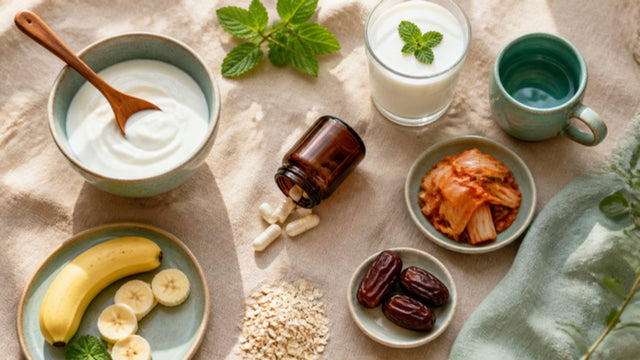

Prebiotics vs Probiotics: What's the Difference?
Prebiotics and probiotics sound almost identical, sit side by side on pharmacy shelves and are often sold in the same capsule, so it is no surprise they get mixed up. This probiotics guide clears it up: probiotics are live microorganisms, while prebiotics are the food certain gut microbes use. One is the "who", the other is the "what they eat".
Below we explain the official definitions, the main types of each, where they appear in everyday Gulf foods, what "synbiotic" and "postbiotic" mean on a label, and a simple way to decide which, if either, fits your goals.
- Probiotics are live microorganisms that, in adequate amounts, may offer a health benefit. Effects depend on the specific strain.
- Prebiotics are substrates, mostly certain fibres such as inulin, FOS and GOS, that are selectively used by beneficial gut microbes.
- All prebiotics are fibre-like, but not all fibre is prebiotic. Onions, garlic, leeks, chickpeas, lentils, oats and slightly green bananas are everyday sources.
- A synbiotic combines both; a postbiotic contains inactivated microbes. Read the label to see which you are buying.
- Prebiotics commonly cause wind and bloating if you start high. Build up slowly, and check with a doctor if you have IBS or another gut condition.
The one-line difference
Think of your gut microbiome as a garden. Probiotics are seeds or seedlings you add. Prebiotics are the fertiliser that helps certain plants already growing there to thrive. You can add seedlings without fertiliser, feed the garden without planting anything new, or do both.
The analogy has limits. Most probiotic microbes pass through the gut rather than settling permanently, and a prebiotic only "counts" if it is used selectively by microbes in a way that has been linked with a health benefit. But it captures the core idea: one is living, the other is food. If you are new to how digestion and the microbiome work, start with our beginner's guide to gut health.
Probiotics guide: what counts as a probiotic
The internationally used definition, agreed by an expert panel of the International Scientific Association for Probiotics and Prebiotics (ISAPP) and based on an earlier FAO/WHO definition, is: live microorganisms that, when administered in adequate amounts, confer a health benefit on the host.
Three words in that sentence matter when you shop:
- Live. The microbes need to be alive when you take them, which is why storage and "guaranteed until expiry" counts matter, especially in Bahrain's heat.
- Adequate amounts. The dose is measured in colony-forming units (CFU). More is not automatically better; what matters is the amount used in research for that strain.
- Health benefit. Benefits are strain-specific. The US National Center for Complementary and Integrative Health (NCCIH) notes that findings for one strain do not automatically apply to another, even within the same species.
Common probiotic groups on labels
- Lactobacillus (now split into several new genus names, such as Lacticaseibacillus rhamnosus) and Bifidobacterium are the most studied.
- Streptococcus thermophilus is a classic yoghurt culture.
- Saccharomyces boulardii is a probiotic yeast.
- Bacillus species form spores and appear in some newer multi-strain formulas.
Food sources include live yoghurt, laban, kefir and some fermented vegetables, although not every fermented food contains live microbes in a known amount, and fermented foods are not automatically "probiotics" in the strict sense. For a closer look at when people consider a supplement, see 10 signs your gut may need probiotics.
Prebiotics: the fibres that feed your microbes
ISAPP's updated 2017 consensus defines a prebiotic as a substrate that is selectively utilized by host microorganisms conferring a health benefit. In practice, the best-established prebiotics are certain non-digestible carbohydrates that pass undigested to the large intestine, where specific bacteria, often Bifidobacterium, ferment them.
That fermentation produces short-chain fatty acids such as butyrate, which researchers are studying for their role in gut lining health. The key word is "selectively": general fibre feeds many microbes, while a prebiotic favours particular beneficial groups.
The main prebiotic types
| Prebiotic | Where you find it | Good to know |
|---|---|---|
| Inulin and fructo-oligosaccharides (FOS) | Onion, garlic, leek, asparagus, chicory root, Jerusalem artichoke, wheat | The most studied. In the EU, chicory inulin may carry a claim for normal bowel function at 12 g a day. A common trigger for wind. |
| Galacto-oligosaccharides (GOS) | Chickpeas, lentils, beans; added to some infant formulas | Strongly bifidogenic. Pulses are an easy Gulf-kitchen source. |
| Resistant starch | Slightly green bananas, oats, cooked-then-cooled rice and potatoes, lentils | Classed as a "candidate" prebiotic; behaves like fibre. |
| Acacia (gum arabic) fibre | Acacia powder supplements | Soluble, slowly fermented and often described as gentler on the stomach. |
| Xylo-oligosaccharides (XOS) | Bamboo shoots, some fruits; added to supplements | Studied at relatively small doses; appears in some synbiotic capsules. |
| Polyphenols | Dates, berries, green tea, cocoa, olive oil | Not fibres, but ISAPP recognises some as candidate prebiotics. Research is early. |
One important point: all prebiotics behave like fibre, but not all fibre is prebiotic. Psyllium, for example, is an excellent bulking fibre for regularity but is only lightly fermented, so it is not usually classed as a prebiotic. Both have a place, and the NHS recommends adults aim for 30 g of fibre a day from a mix of sources.
The Bahrain angle
A traditional Gulf table is quietly rich in prebiotics. Machboos and saloona start with onion and garlic; chickpeas turn up in hummus and nakhi, the spiced chickpeas loved in Ramadan; lentil soup (shorbat adas) is an iftar staple; and dates bring fibre and polyphenols. Pair these with live laban or plain yoghurt and you already have a "food-first synbiotic" plate. Two local tips: cooked-then-cooled rice from yesterday's machboos contains more resistant starch than freshly cooked rice (reheat it thoroughly and store it in the fridge promptly for food safety), and in summer keep live-culture products out of hot cars and store them as the label directs.
Side by side: prebiotics vs probiotics
| Probiotics | Prebiotics | |
|---|---|---|
| What they are | Live microorganisms (bacteria or yeasts) | Non-living substrates, mostly specific fibres |
| Main job | Add specific microbes that may offer a strain-specific benefit | Feed beneficial microbes already in your gut |
| Everyday foods | Live yoghurt, laban, kefir | Onion, garlic, leek, chickpeas, lentils, oats, slightly green bananas |
| How dose is shown | CFU (for example "10 billion CFU"), ideally per named strain | Grams or milligrams of the fibre (for example "5 g inulin") |
| Storage | Heat- and moisture-sensitive; some need the fridge | Stable at room temperature |
| Common early side effects | Mild wind or bloating for a few days | Wind, bloating and cramping, especially at higher doses |
| Best-studied situations | Specific strains alongside antibiotics | Bowel regularity (chicory inulin); boosting bifidobacteria |
| Food-first option? | Partly (fermented foods) | Yes, easily through plants and pulses |
Prebiotic, probiotic and synbiotic picks
Chosen by the Healthana Team to show each category clearly: prebiotic fibres, probiotics and combined formulas. Always read the label before use.


Synbiotics and postbiotics: the newer label words
Synbiotics
ISAPP defines a synbiotic as a mixture of live microorganisms and substrates selectively used by host microorganisms that confers a health benefit. In plain terms: a probiotic and a prebiotic in one product. Many capsules now add a small amount of inulin, FOS or XOS. For example, Sundance Probiotic-14 with Prebiotic pairs 14 strains with 100 mg of organic inulin, and Health Aid Acidophilus Plus combines cultures with FOS.
Keep the numbers in perspective: 100 mg of prebiotic is a small amount compared with the several grams used in many prebiotic studies, so it is a supporting extra rather than a full prebiotic dose. Your daily plate still does most of the feeding.
Postbiotics
A 2021 ISAPP consensus defines a postbiotic as a preparation of inanimate (non-living) microorganisms and/or their components that confers a health benefit. You may see "tyndallized" or "heat-treated" strains on labels, as in OLONEA bacteflora® Plus. Research on postbiotics is young, and the term is still being standardised by regulators, so treat claims cautiously.
| Label term | Contains | Example on the label |
|---|---|---|
| Probiotic | Live microbes | "L. rhamnosus GG, 10 billion CFU" |
| Prebiotic | Selectively used substrate, usually fibre | "Inulin 5 g", "acacia fibre", "GOS" |
| Synbiotic | Both of the above | "Probiotic with prebiotic FOS" |
| Postbiotic | Inactivated microbes or their parts | "Tyndallized strains", "heat-treated" |
Which one do you need? A quick decision guide
Most people do not need to choose a supplement at all; the first step is food. Use this checklist to see where you are:
| Your situation | Most sensible starting point |
|---|---|
| Low intake of vegetables, pulses and wholegrains | Prebiotic foods first. A prebiotic or fibre supplement can help fill the gap. |
| Want to support regularity | Fibre, fluids and movement. Chicory inulin and psyllium are well-studied options. |
| On or just finishing antibiotics | Ask your pharmacist about a specific probiotic strain and timing. |
| Already eat plenty of plants and want an extra step | A named-strain probiotic or a synbiotic may be an optional add-on. |
| Prefer one daily product | A synbiotic, accepting that its prebiotic dose is usually small. |
| Sensitive gut or diagnosed IBS | Speak to your doctor or dietitian first; high-FODMAP prebiotics may worsen symptoms. |
- Probiotic: full strain names, CFU per strain or per serving, and whether the count is guaranteed until expiry
- Prebiotic: the type of fibre (inulin, FOS, GOS, acacia, XOS) and the amount in grams or milligrams
- Synbiotic: check that the prebiotic dose is stated, not just listed
- Storage instructions: room temperature or refrigerate after opening
- Age guidance, allergens and sweeteners (some gummies contain sugar or maltitol)
How to start a prebiotic without the bloat
- Start low. Begin with a small serving, such as half a sachet or one gummy, and increase over one to two weeks.
- Drink more water as you add fibre, especially in summer heat.
- Spread it out across the day rather than taking a large dose at once.
- Change one thing at a time so you can tell what suits you.
For a single-ingredient fibre, Perfect Life Prebio-T or Prebio-M mix into water or food; for a flavoured option, the RITE Gut Health Prebiotic Drink Mix combines three fibres. Browse the full Digestion, Metabolism & Probiotics range or the Probiotics collection.
Side effects, FODMAPs and who should check first
Both are generally well tolerated by healthy adults, but they work differently, so the cautions differ too.
- Prebiotics and wind. Because microbes ferment them, inulin, FOS and GOS often cause gas, bloating or cramps, especially when you start high. Inulin, FOS and GOS are also FODMAPs (fermentable carbohydrates), which Monash University research shows can trigger symptoms in people with irritable bowel syndrome.
- Probiotics and immunity. The NCCIH reports that probiotics have a good safety record in healthy people, but serious infections have been reported in people with serious illnesses or weakened immune systems, and in premature babies.
- Medicines. If you take antibiotics or antifungals, ask your pharmacist about timing. Some labels advise leaving 3 to 4 hours between an antibiotic and a probiotic.
Speak to your doctor or pharmacist before starting either if you:
- Have a weakened immune system, a serious illness, a central line, or have recently had surgery.
- Have IBS, inflammatory bowel disease, small intestinal bacterial overgrowth (SIBO) or another digestive condition.
- Are pregnant or breastfeeding, or are buying for a baby or young child.
- Notice red-flag symptoms such as blood in your stool, unexplained weight loss or a bowel change lasting several weeks. These need a doctor, not a supplement.
Looking at gut health as part of overall wellbeing? Our guide to supporting your immune system covers the everyday habits that matter, and Gut Health 101 lists ten daily habits for a happier gut.
Probiotics add specific live microbes; prebiotics feed the helpful ones you already have. For most people the biggest, cheapest win is prebiotic food: onions, garlic, pulses, oats and the occasional slightly green banana, alongside laban or yoghurt. If you want a supplement, decide what job it should do, choose a clearly labelled prebiotic fibre, a named-strain probiotic or a synbiotic accordingly, start slowly, and ask your pharmacist if you take medicines or have a gut condition.
Frequently asked questions
What is the main difference between prebiotics and probiotics?
Probiotics are live microorganisms that, in adequate amounts, may offer a health benefit. Prebiotics are substrates, mainly certain fibres such as inulin, FOS and GOS, that are selectively used by beneficial microbes already living in your gut. In short, probiotics are the microbes and prebiotics are their food.
Should I take prebiotics and probiotics together?
You can. A product containing both is called a synbiotic. Many people get prebiotics from food, such as onions, garlic, pulses and oats, while taking a probiotic supplement. If you choose a combined product, check how much prebiotic it contains, because the amount is often small.
Are prebiotics just fibre?
Prebiotics behave like fibre, but not all fibre is prebiotic. A prebiotic must be selectively used by beneficial microbes in a way linked with a health benefit. Inulin, FOS and GOS are classic prebiotics, while psyllium is a useful bulking fibre that is not usually classed as one.
Why do prebiotics make me gassy?
Gut microbes ferment prebiotic fibres, which produces gas. This is common when you start with a large amount. Begin with a small serving, increase gradually over one to two weeks and drink plenty of water. If symptoms are severe or you have IBS, speak to your doctor or a dietitian.
What is a postbiotic?
A postbiotic is a preparation of non-living microorganisms or their components that may offer a health benefit. You may see terms such as tyndallized or heat-treated strains on labels. Research on postbiotics is still early.
Explore on Healthana
Label-first guidance, made for Bahrain
Every product on Healthana shows its label facts in English and Arabic. Not sure what suits you? Our team is happy to help.
- Hill C et al. — ISAPP consensus statement on the scope and appropriate use of the term probiotic (Nat Rev Gastroenterol Hepatol, 2014)
- Gibson GR et al. — ISAPP consensus statement on the definition and scope of prebiotics (Nat Rev Gastroenterol Hepatol, 2017)
- Swanson KS et al. — ISAPP consensus statement on the definition and scope of synbiotics (Nat Rev Gastroenterol Hepatol, 2020)
- Salminen S et al. — ISAPP consensus statement on the definition and scope of postbiotics (Nat Rev Gastroenterol Hepatol, 2021)
- ISAPP — Prebiotics resources
- Commission Regulation (EU) 2015/2314 — authorised health claim for chicory inulin and normal bowel function
- NCCIH — Probiotics: What You Need To Know
- NHS — Probiotics
- NHS — How to get more fibre into your diet
- Monash University — About FODMAPs and IBS
Share